从有想法到实施,不超过24小时,这是007之前用ASP+ACCESS来开发的那种能力是不敢想象的。
昨天2026年11月9日,看到一个关于Audiolingual Method(Army Method)的语言学习方法。其核心就是极致重复(高密度口头模仿),快到可以把翻译过程干掉。形成肌肉记忆,条件反射。这个方法的核心就是Pattern drills(句型操练).
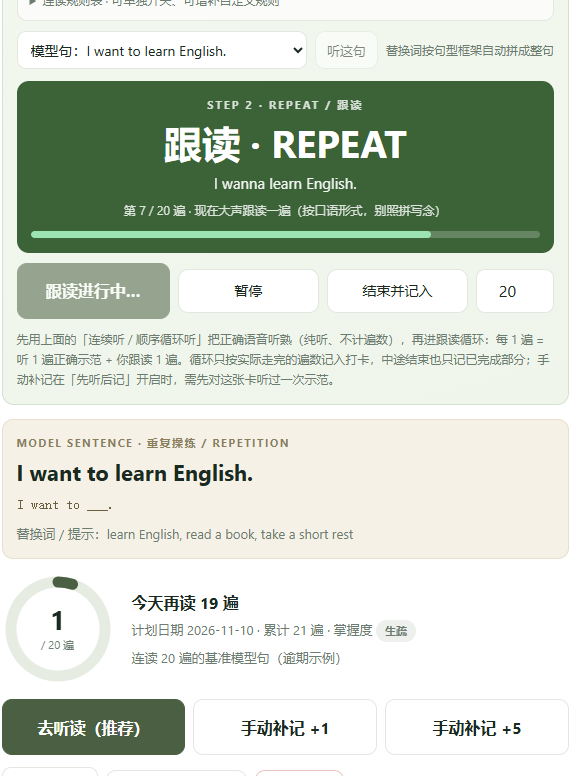
有了参考理论,就有了动力,说干就干,今天(2026年11月10日)在办公室把昨天用【问宝包】(千问元宝豆包)搜索并验证的Pattern drills操练从定义到操作方式,生成了基础的30个句型,下一步扩展到三位数,每个句型从A1、A2到B1、B2水平。最终用Workbuddy做出了我的新项目《LBC Project》( Language Base Camp),中文名称比较大:语言根据地。007我将创建自己的语言根据地,以此为大本营,一个句型又一个句型地训练,直到变成肌肉记忆。
In language teaching, pattern drills commonly include several types: Repetition Drill, Substitution Drill, Transformation Drill, Expansion Drill, and Response Drill.
1.Repetition Drill is the first step of practice. Each type serves a distinct purpose. Repetition Drill lets learners repeat the target model sentence to get familiar with its form and pronunciation.
2.Substitution Drill helps learners notice and practise fixed sentence frames.
3.Transformation Drill trains learners to change a sentence into another grammatical form.
4.Expansion Drill helps learners build longer, more complex sentences from simpler ones.
5.Response Drill develops the ability to give appropriate, quick replies to prompts.
Together, these drills help learners internalize sentence patterns, strengthen grammatical awareness, and gradually develop more automatic and accurate language use.
【定义】
锁定一个固定句型框架(pattern),在受控条件下做重复、替换、变形,强制大脑对这个句式形成自动化提取;训练重心是句式结构、发音节奏、语序习惯,而不是自由创造表达。
【我为什么要这么去做】
I subscribe to the principle that during the initial foundational phase — the critical stage for skill building — intense, focused effort yields transformative results. That’s why I’ve made pattern drills my standard practice.
从背单词、背诵背后概念英语课文,盲听牛津入级故事,耳朵有了敏感度,但对于听句子,对话类还是跟不上,说白了就是没有刻意去训练句型,没有预制件的原因。找到问题所在,剩下交给时间,付诸行动完事。
这就像在爬山。开始之前做选择,一旦开始之后,就放弃思考,只专注于脚步。如果总在找方法,英语是学不到骨子里的,也不成不了本能,谈不上掌握一门语言,那句话(I want to become bilingule)也就只是想一想罢了。
截图为凭——
关于FSI方法
Pattern drills 最早成型于二战时期的美国。当时美军需要士兵在短时间内掌握外语口语,于是出现了被称为 “Army Method / 军队法” 的训练方式。
FSI(Foreign Service Institute,美国外交学院)方法,是美国国务院为外交官研发的极速口语训练法,核心在于“把语言练成条件反射”,通过高强度的模式操练(Pattern Drill)实现“脱口而出”,而非传统的“先翻译再输出”。